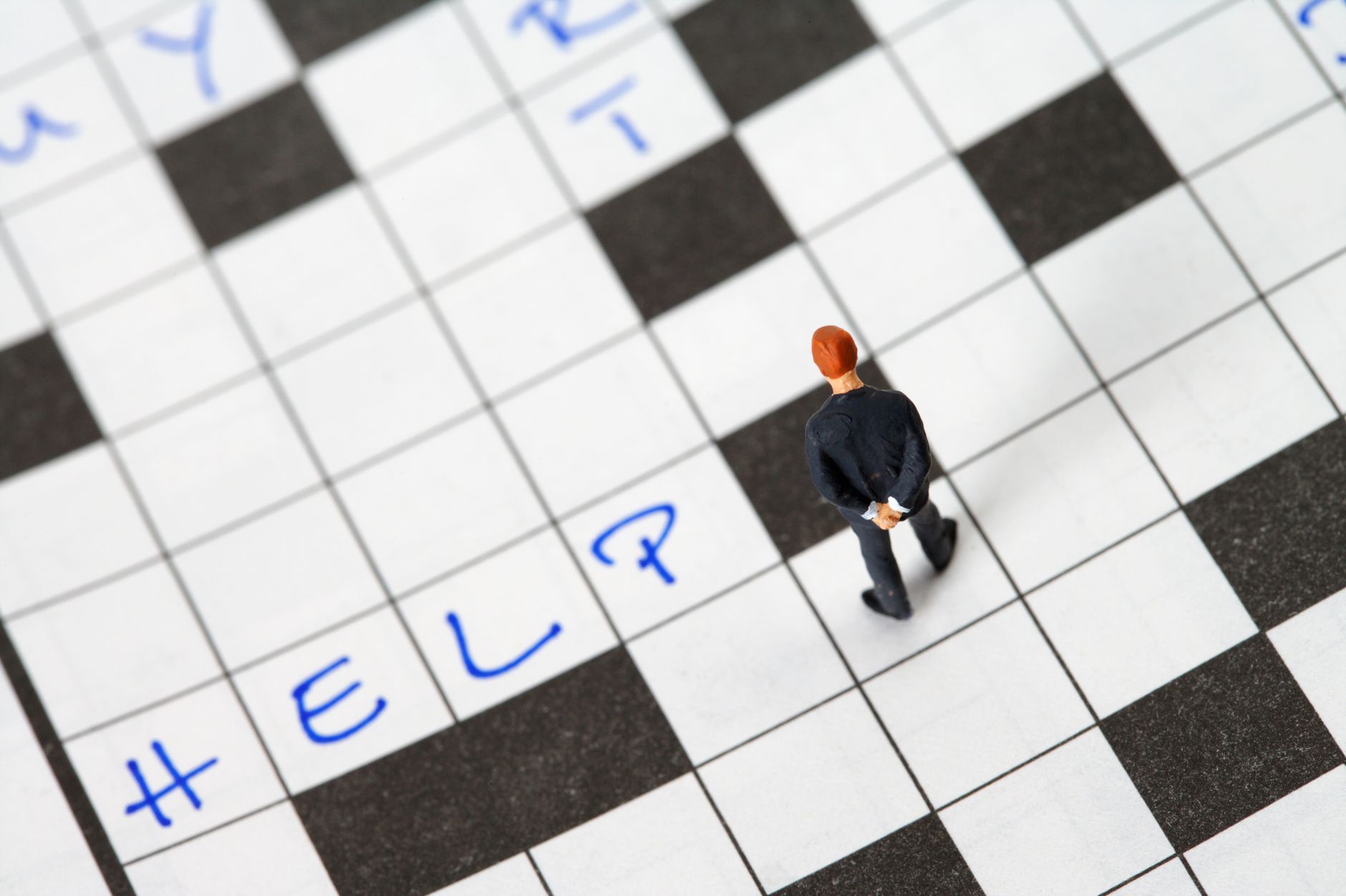
Cryptic crosswords have a reputation for being impenetrable, and for good reason: a clue that looks like a sentence is rarely what it seems. But once you understand the core techniques, the fog lifts. Anagrams, hidden words, and charades are the three building blocks that appear in almost every cryptic grid. Spot one of them inside a clue, and you've already won most of the fight.
How anagram clues work
An anagram clue gives you all the letters of the answer, scrambled. The clue always contains two parts: an indicator word (or phrase) that signals scrambling is involved, and a set of letters to rearrange. The definition of the answer sits at either the beginning or the end of the clue. Never in the middle.
Common anagram indicators include words like "mixed," "broken," "wild," "confused," "out," "revised," and "arranged." Any word that implies disorder or change can serve as the signal. Consider this example:
Wild tiger stalks forest (6)
"Wild" is the indicator. "Tiger" is the fodder (the letters to scramble). Rearranging T-I-G-E-R gives you TIGER itself, but check the letter count: five letters, not six. So the fodder might be two words combined. "Tiger stalks" gives you ten letters, too many. In practice, the setter will make the fodder letter count match the answer exactly, so counting is your first move whenever you suspect an anagram. If you enjoy the letter-juggling side of things, the broader world of anagram games is a natural companion to this skill.
One useful habit: underline every potential indicator word before you decide anything. Setters love to hide indicators inside ordinary-looking phrases. "Reform," "in a stew," "scrambled," and "off" all flag anagrams in the right context.
Hidden word clues: the answer hiding in plain sight
Hidden word clues (also called containers or embedded clues) conceal the answer inside the clue itself, running consecutively through two or more words. The definition still appears at one end.
Indicator phrases for hidden words include "in," "within," "some of," "part of," "contained in," and "found in." Look at this example:
Some athletes train for speed (5)
The indicator is "some." Read across the clue: athlETES Train. The answer is ETEST? No. Try again: athleTES Train. Still not clean. Work letter by letter. a-t-h-l-e-t-e-s-t-r-a-i-n. Pull out five consecutive letters: "TRAIN" sits right there in the final word, but that's just the word itself. Try: athleteSTRAIn gives STRAI, which isn't a word. The key lesson: hidden word clues require patience and a willingness to slide your window across the full string of letters character by character. With practice you'll clock them in seconds.
Hidden word clues are among the fairest in cryptics because the answer is literally written out for you. That's also why setters use them sparingly. When you spot a "within" or "some of" in a clue, treat it as a gift.
Charade clues: building the answer piece by piece
A charade clue constructs the answer by joining two or more smaller words or word fragments, one after the other, like a spoken charade game. Each component is clued separately, and the components combine to make the final answer. The definition sits at one end, as always.
Unlike anagrams, charades don't use disorder indicators. Instead they might use linking words: "and," "after," "then," "following," "plus," or simply nothing at all. Here's a clean example:
Sound produced by a church instrument (5)
"Church" in cryptic crossword convention almost always signals CE (Church of England) or CH. "Instrument" might clue ORGAN. But five letters: CH + ORD? Or perhaps "sound" is the definition and "produced by a church instrument" gives you a component. This is where charades demand that you hold the definition and the wordplay in two separate mental tracks simultaneously.
Setters use abbreviations constantly in charades. Some reliable ones: "doctor" = DR or MB, "university" = U, "note" = C, D, E, F, G, A, or B, "street" = ST, "point" = N, S, E, or W. Building a personal reference list of these shorthand conventions speeds up charade-solving enormously.
Mixing techniques in one clue
Setters don't always keep techniques separate. A clue might ask you to anagram one fragment and then attach it to a straight abbreviation. These hybrids are more common at the advanced end of the difficulty scale. If a clue resists your first read, consider whether two techniques might be operating at once.
The discipline of identifying techniques also trains a habit that pays off across all word puzzles. If you're still building your general puzzle vocabulary, the guide on how to solve crossword puzzles covers the foundational pattern-recognition skills that underpin all cryptic work.
Putting the techniques into practice
The fastest way to internalise these three clue types is targeted repetition. When you pick up a cryptic grid, go through every clue and label it before you try to solve: anagram, hidden word, charade, or unknown. The labelling habit forces you to read for structure rather than meaning, which is exactly the mental shift cryptics demand.
Start with hidden word clues. They reward you fastest and confirm that your indicator-spotting eye is working. Move on to anagrams, which reward fast letter rearrangement. Charades last, because they require the broadest knowledge of abbreviations and compound wordplay. Once you're comfortable with all three, try working through 10 cryptic crossword clues to test your skills and see how many you can label before solving.
Cryptic setters use these techniques because they create clues with one clean, unambiguous answer. The wordplay and the definition always converge on the same word. When they do, you feel it. That's the click every cryptic solver is chasing.