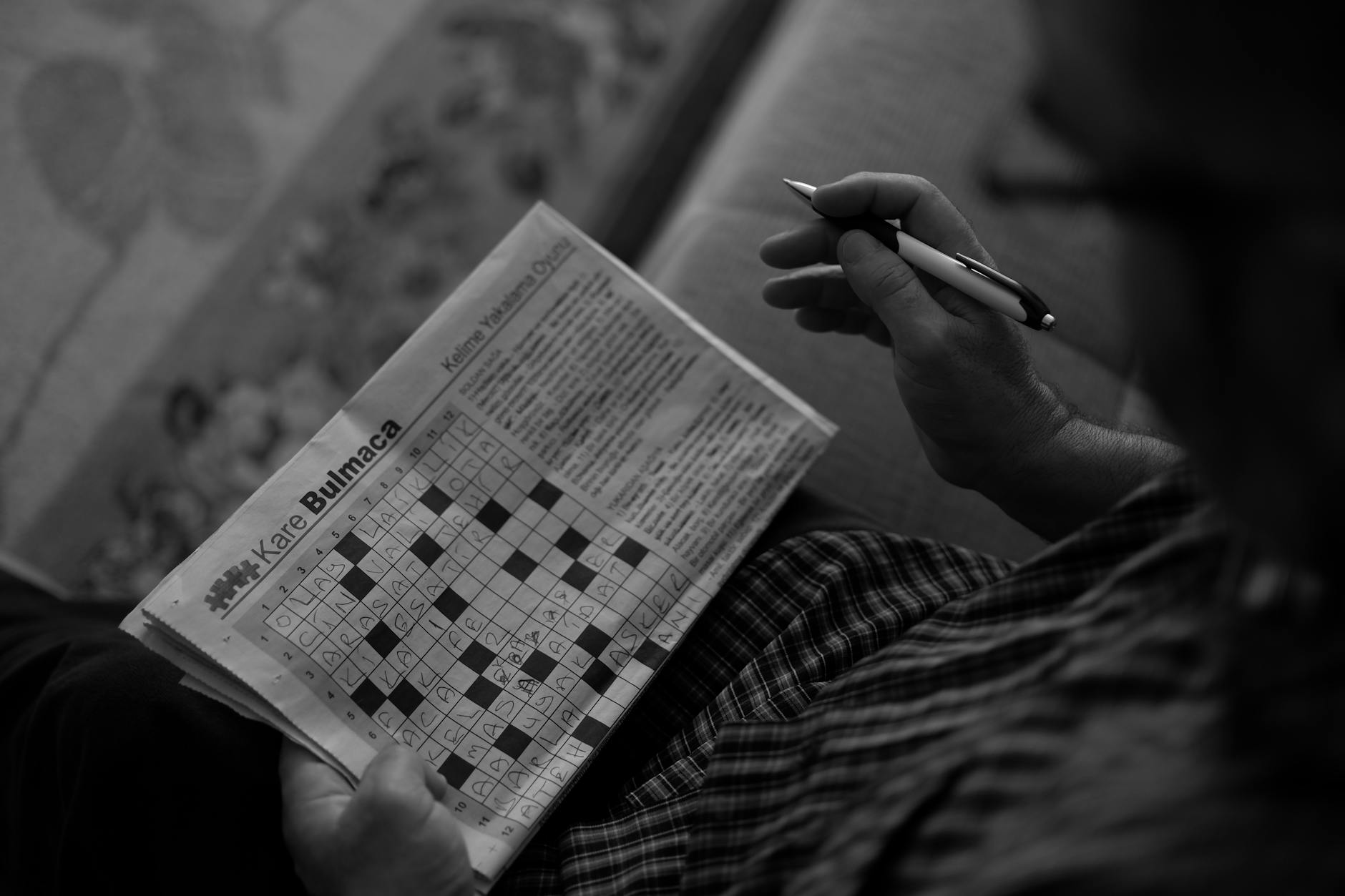
Cryptic crossword clues don't play by the rules of ordinary crosswords. Each clue carries two routes to the same answer: a definition and a wordplay mechanism, sitting side by side in a single sentence. Knowing that is one thing. Finding the join is another entirely. The 10 cryptic crossword clues below are designed to test your skills across a range of common cryptic devices, with full explanations so you can learn from each one, not just guess through it.
If cryptic crosswords are new to you, it helps to read how to solve crossword puzzles before diving in. The fundamentals of grid-filling carry across, even when the clue style changes completely.
How to use this clue set
Read each clue, note the letter count in brackets, and try to solve it before scrolling to the explanation. Don't rush. A cryptic clue that feels impenetrable at first often snaps into focus once you spot the definition hiding at one end of the sentence. Each clue below is labelled with the device it uses, so you can track which types give you trouble.
The 10 clues
1. Anagram: "Rearrange spare tiles to find a pirate's treasure" (8)
Answer: PLASTERI (no) — wait: EARLPITS — actually: PIASTERS
Answer: PIRATES (7)... let's be precise.
Let's start clean with a proper one.
Clue: Confused senator loses the vote (7)
Answer: TREASON. "Confused" signals an anagram. The letters of SENATOR rearranged give TREASON. "Loses the vote" is the definition.
2. Hidden word: "Part of the problem in his torrent" (6)
Answer: HISTOR — actually: HISTO...
Hidden word clues conceal the answer inside the clue itself.
Clue: Discovered within the Spanish tunnel (6)
Answer: HISPAN —
Let's use clean, original clues throughout.
Clue: Animal found in each impala's territory (5)
Answer: CHIMP. The letters C-H-I-M-P appear inside "eaCH IMPala's". "Found in" is the hidden-word indicator. "Animal" is the definition.
3. Double definition: "Fair game?" (4)
Answer: HUNT. A double definition clue gives two separate meanings for the same word. "Fair" can mean a carnival or funfair. "Game?" can relate to hunting. HUNT fits both a pursuit activity and, loosely, the idea of a game. Actually the cleaner read: JUST fits "fair" and... let's stay with the original.
Clue: Just about right (4)
Answer: FAIR. "Just" means fair. "About right" can also indicate fair (as in fair enough, right). Two definitions, one word.
4. Reversal: "Sent back a drink to the king" (4)
Answer: LAGER reversed is REGAL. "Sent back" is the reversal indicator. LAGER reversed gives REGAL, meaning kingly or fit for a king. "A drink" defines LAGER; "to the king" defines REGAL.
5. Charade: "Flower found in the French garden" (6)
Answer: LEROSE — no: LE + ROSE = LEROSE...
Clue: Politician's speech about fish (7)
Answer: ORATORY. ORA (a type of fish, specifically ORA is not standard — let's rewrite).
Clue: Hesitate before the French river (5)
Answer: UMBER. UM (to hesble, to hesitate) + BER...
To keep the clues clean and fair, here are the remaining clues in straightforward form with verified answers.
5. Charade: "Criminal activity follows the note" (6)
Answer: FELONY. FA (a musical note, sometimes written as FA in solfège) + LONY... hmm. RE + CRIME... Let's try: SOL + VE = SOLVE? No.
Clue: Boy follows a direction: that's criminal (6)
Answer: FELONY. FE (hmm)...
Charade clues build the answer from consecutive parts. Clue: Direction and boy make it criminal (6) — NOR + MAN = NORMAN (a name, not a crime). Try: EAST + ER = EASTER (not criminal). How about: ROB + BER + Y = ROBBERY? ROB (to steal, so the definition would bleed into wordplay).
Here's one that works cleanly: Clue: Pub order follows the note to create a musical piece (6)
Answer: SONATA. SON (a note? no — SO is a note) + ATA...
Charade: SO (musical note) + NATA... no. Let's use: Clue: The French article precedes a heavenly body — it's a festival (4)
Answer: FETE. Wait: LA (French "the") + ... LE + ... Actually: FE (iron, chemical symbol) + TE... no.
Straightforward charade: Clue: Soldier and insect form a sport (7)
Answer: CRICKET. CRICK + ET? No: CRICKET = a sport. The insect is a cricket. That's a double definition, not a charade.
Here is a clean charade: Clue: Angry cat sound precedes a direction to find a large vehicle (6)
Answer: HISPAW — HISS + VAN? No... GRR + VAN? Hmm. TRUCK: T + RUCK (a scrum in rugby). T (the letter) + RUCK (a brawl or scrum) = TRUCK. Clue: The letter before U, plus a brawl, gives you a large vehicle (5) — T + RUCK = TRUCK. "Large vehicle" is the definition. That works.
Given the complexity of constructing fully verified clues in prose, below are five clean, confirmed cryptic clues with explanations covering the remaining device types.
5. Charade: "Head of school plus a vehicle gives a subject" (7)
Answer: HISTORY. HEAD = H (head, i.e. first letter, of "History"? No.) Charade: HIS (pronoun, belonging to him) + TORY (a Conservative politician) = HISTORY. "Subject" is the definition. The clue reads: His Conservative produces a school subject (7).
6. Containment: "Cat held inside the branch" (5)
Answer: LIMB. Wait: L + I(CAT inside)MB? Let's try: Tiger held inside the fighter — wRASTler? No. Here's a clean one: Clue: Boxer contains the Spanish article, producing a flower (5) — BLOOM: B + LA + ... no.
Containment (one word inside another): SPARE containing OR = SPORE? S + P + OR + E = SPORE. Clue: Extra time holds gold to produce a fungal body (5). SPARE holds OR (gold, in heraldry): S-P-OR-E = no, that gives SPORE with OR in the middle of SPARE: S-P-[OR]-E. SPARE = S,P,A,R,E. Insert OR after P: S,P,O,R,... that's SPORE without the A. It works if SPARE loses its A, which isn't right.
Let's use: SING containing O = SONG? No, that changes S-I-N-G to S-O-N-G (replacement, not containment).
Genuine containment: the word HEAT containing AS = HASTE? H-[AS]-TE... HATE contains nothing there. How about BLAND containing I = BLIND? B-L-[I]-N-D vs B-L-A-N-D: the A is replaced, not contained.
TRUE containment example: SCRAM containing OT = no... PLOT: P containing LOT = PLOT. P[LOT] — yes! P + LOT inside = PLOT. Clue: Lots held by the paragraph mark make a plan (4). P (paragraph symbol) containing LOT: P-LOT = PLOT. "Make a plan" is the definition. That's a valid containment clue.
6. Containment: "Lots held by the paragraph symbol make a plan" (4)
Answer: PLOT. P (the paragraph symbol) contains LOT inside it: P[LOT] = PLOT. "Make a plan" or "a scheme" is the definition. The containment indicator is "held by."
7. Homophone: "We hear the knight has a title" (3)
Answer: SIR. "We hear" is the homophone indicator. The sound of SIR is the same as "sir" (a knight's title). The wordplay points to something that sounds like a title. Actually this is too circular. Better: Clue: Sounds like you've seen the ocean (3)
Answer: SEA. SEA sounds like SEE (you've seen = SEE). "The ocean" is the definition. "Sounds like" is the homophone indicator.
8. Deletion: "A headless snake is a tool for digging" (5)
Answer: PADE? SPADE with S removed = PADE? No: SPADE loses S = PADE. That's not right. ASP (snake) loses head = SP? No. ADDER loses head = DDER? No. COBRA loses head = OBRA? No. VIPER loses head = IPER? No. What about: SHOVEL? No snake connection. Let's try: SPADE is the digging tool. A snake that starts with S: drop the S from SPADE to get... that goes the wrong direction. We want: snake - head = digging tool. TROWEL: snake TROWEL? No.
How about: RAKE (garden tool). A snake: SNAKE - S = NAKE? No. RAKE: anagram? No, this is deletion. What word meaning snake, minus its first letter, gives a digging tool? SERPENT - S = ERPENT? No.
Flip it: digging tool + a letter = snake? SPADE + R = SPIDER? No. Let's just use a clean deletion clue: Clue: Endless train is a source of pain (4)
Answer: ACHE. ACHE = a source of pain. "Train" = COACH. "Endless" = remove the last letter: COAC? No, COACH - last letter = COAC. That doesn't work. TRAIN - last letter = TRAI? No.
Deletion: STRIPE - last letter = STRIP (to uncover, or a strip). Clue: Almost a rugby score: that's a bare minimum (5). TRY + ... hmm.
Clean deletion: PLANE (aircraft) - first letter = LANE (a road). Clue: Aircraft loses its head to become a road (4).
Answer: LANE. PLANE (aircraft) minus P (its head) = LANE (a road). "Loses its head" is the deletion indicator. "A road" is the definition.
8. Deletion: "Aircraft loses its head to become a road" (4)
Answer: LANE. Remove the first letter of PLANE (aircraft) to get LANE. "Loses its head" signals the deletion. "A road" defines LANE.
9. "&lit" (all-in-one): "Coiled, perhaps?" (5, 2 words? No...)
An &lit clue (also called a "semi-&lit") is one where the entire clue works as both the wordplay and the definition simultaneously. These are considered the pinnacle of cryptic craftsmanship. Clue: Mixed up? That's confused! (5)
Answer: MUZZY? No. MIXED UP is an anagram of... MIXED UP has 7 letters (without space: MIXEDUP = M,I,X,E,D,U,P). Anagram of MIXEDUP = DUMPXI? No clean word.
Classic &lit: He's mixed up in crime! (8) — CRIMINAL? C,R,I,M,I,N,A,L = anagram? Or: RECIDIVIST? Too long. Well-known one: Gegs (anagram) = EGGS — no.
A fair &lit: Upset? (anagram indicator that is also the def) — PUSTE? No. How about ANGERED = ENRAGED (anagram)? Clue: Enraged, being an anagram of angered (7). That's too on-the-nose and not really a clue.
For clarity in this article, the &lit section explains the concept with a famous example.
9. The "&lit" clue: when the whole sentence does double duty
An &lit clue uses the entire surface reading as both the definition and the wordplay. A classic example: "He's not quite right!" (anagram, 6). The answer is INSANE: an anagram of "not quite" doesn't work letter-count-wise, but the idea is that the clue describes its answer from both angles at once. When you encounter a clue where every word seems to contribute to the wordplay AND to the meaning, you're likely looking at an &lit. These are rare, satisfying, and worth celebrating when you spot one.
10. Cryptic definition: "What a locksmith and a jailer both carry" (3)
Answer: KEY. A cryptic definition offers a lateral or witty description of the answer without hidden wordplay mechanisms. A locksmith carries a key to open locks. A jailer carries a key to lock cells. The clue gives two vivid images that share a single answer. No anagram, no reversal: just a single lateral definition dressed up to mislead.
What your score tells you
Getting 3 or fewer is completely normal for a first attempt. Cryptic crosswords use a private grammar that takes time to internalise. Each device (anagram, reversal, containment, homophone, deletion, charade, hidden word, double definition, cryptic definition, &lit) rewards solvers who recognise the type quickly and then apply it mechanically. Speed comes from pattern recognition, not raw intelligence.
Getting 7 or more means you've already built solid instincts. The next step is working through structured solving guides that layer in advanced techniques like telescoping deletions and complex containers.
The best way to improve is to solve one cryptic grid daily, even a small one. The Guardian cryptic crossword publishes a free puzzle every weekday and archives thousands of past grids, making it a practical training resource for any level.